Jan Steen (1625/1626–1679)
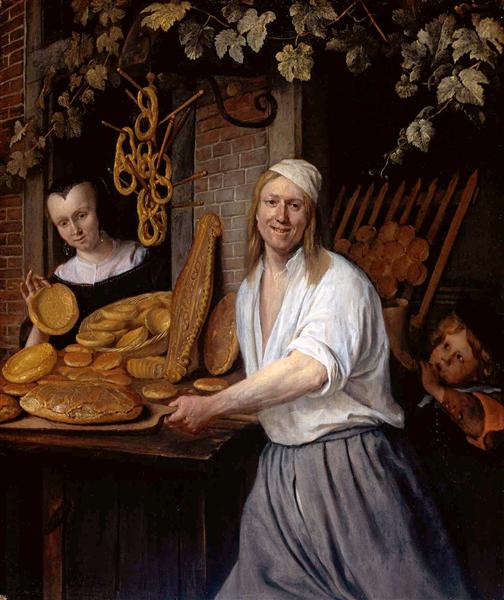
What is there to say besides? Wow! Please, open a bakery in my town! The cheerful handsome baker and his wife showing of a selection of their breads captures, forever, the spirt we find in bakeries throughout the world. Proud artisans. The baking couple was not invented in the 17th century. The couple, whether within the context of monogamous or polygamous relationships is a foundational human social structure. As has the bread bakery been for thousands of years. After the first dazzle from the bread, I want you to note the relationship we see here between Arent and Catharina, and between the two of them and their bakery product.
The foundational bread recipe is love.
The foundational bread recipe is pride in craft.
This will always have been true. Bread is a woman’s craft. Our association of baking with men is an association between men and the commercial baking trade. Women, historically responsible for young children and the responsibility of maintaining the home, make poor commercial bakers. In this image of a baking couple, we see Catherine associated with a light bread that is more pastry than bread. I did not recognize this bread when I first saw it in this painting on a visit to Amsterdam’s the Rijksmuseum. Once, and this is more than twenty years ago, I saw it in the window of a closed bakery in New York’s Lower East Side. I recall going back to the bakery when it was opening, and asking about the bread, but not getting an answer that was helpful.
Then, years later, but many years ago, I was searching the Internet for a “baked pancake.” I don’t quite recall why. Probably a memory of something my mother had made. It turned out that when I baked this “baked pancake” it looked exactly like the bread of my dreams, the bread Catharina was daintily holding between thumb and forefinger!
It is important to note that Catharine is visually associated with a batch of this fast cooking batter-bread. This is a bread she can make with young children in hand. Even while nursing. It is a bread that fits into a mother’s schedule. The only requirement was that the oven had to be very hot. That is the period after the oven is fired, and before it is cool enough to bake bread. While this too-hot-for-bread period occurs every day at the same time in accordance with the oven’s firing schedule, the too-hot-for bread period could last for some time, even hours, providing ample leeway to bake Catharine’s bread.
All of the baked goods displayed are baked at different stages of the falling oven. There are many ways in which Arent and Catharine could have shared production responsibility. But, by her dress, and the contrasting looseness and informality of her handsome muscular husband, we can infer that the did heavy lifting, the bread kneading, and the baking of the larger loaves, at least.
There is everything about the way Jan Steen has conveyed the relationship between Arent and Catharina that conveys affection between the couple, joint pride in their product, and affection for us, the viewer, their potential customer. We’ve made for you what we make for each other, what we make for our children. Eat our bread and feel cared for.
Here is this bread, as I make it for my wife’s breakfast.
| Ingredient | Baker’s Math Formula | Single Serving American Measure | Single Serving Metric Measure | 450g Flour |
|---|---|---|---|---|
| Flour | 100% | ¼ cup | 30g | 450g |
| Milk | 197% | ¼ cup | 60g | 890g |
| Eggs | 161% | 1 egg | 1 egg | 15 eggs |
Whisk up the ingredients in a bowl. Pre-heat the baking dish over a flame or in the oven. This is an important step. Melt butter in the bottom of the pan until there is an even layer of melted butter. Be generous.
Once the oven has reached its baking temperature of 425F (220C), pour the batter into the pan. It is roughly ¾ of a cup , 175ml for the serving size I make. I bake in a terra cotta oven dish that is 9X6 inches, 24X16 cm. Exact measures not necessary. Experiment with pans.
It will be done in approximately 12 minutes.
I serve for breakfast with maple syrup. Our Dutch friends in the 18th century will have had their own culinary uses, as may you.
 William Rubel
The simplicity of this recipe is a comfort, in light of the complicated times we live in. Thank you, William, for sharing this love.
I wish I could eat like this, but I no longer can. So I am applying the simplicity of this recipe to alternative ingredients.
LikeLike
I tried this this morning and it was delicious. Similar to a popover or Dutch baby, with a nice egg/butter flavor.
LikeLike