Register at EventBrite: https://www.eventbrite.com/e/seminar-45-finding-a-focus-to-bread-culture-in-two-neolithic-breads-tickets-1260147578329?aff=oddtdtcreator
Join me, along with other bread and grain lovers, for my 45th Thursday Bread History Seminar on March 27, at 9:00 am Pacific. We’ll recreate recipes I’ve developed utilizing the archeologist Andreas Heiss’ analysis of the breads. We will taste them, and then talk about where these breads fit into the social structure of the Neolithic settlement where they were found. I think that what we learn from the breads can inform our understanding of bread history more generally, including in our own time.
We will start with the grain. We will be looking beyond the literal description of these ancient breads from the archeologist’s report to ask questions about what they meant to the people who grew them and used them. For example, did grain choice reflect social organization?
What makes these loaves so important is that they were made within the context of a planned community that isolated the houses of the village elite from the houses of the rest of the community with a fence and a gate.
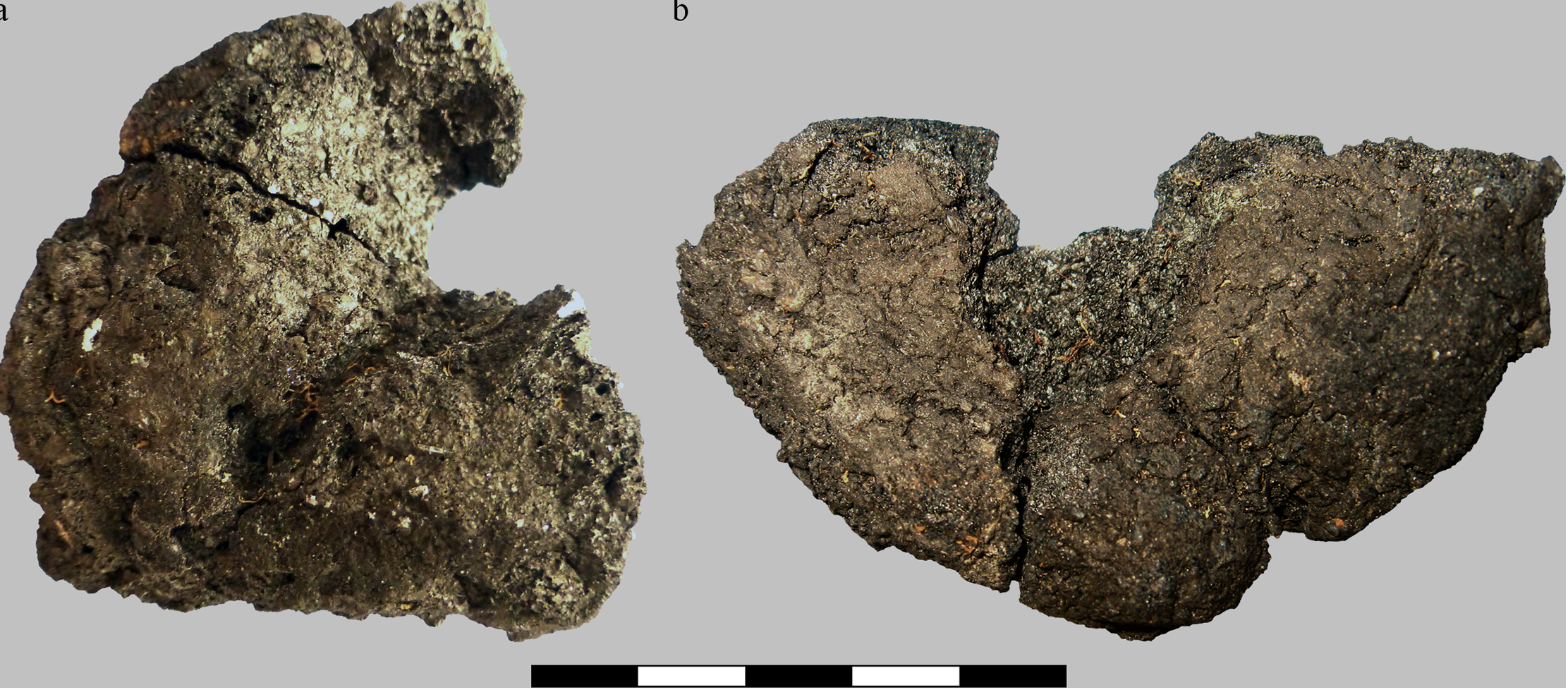
One of the two breads is a crudely ground and crudely made barley bread. The other is a sifted loaf, well crafted, made of emmer and common bread wheat and including celery seeds imported from Italy, along with a deliberately stamped depression in its center.
It is an easy surmise that the bread with the wheat, the imported seeds, and the central stamp belongs to the people in the larger houses. From other studies we can surmise that the wheat has been grown in manured fields while the barely was unfertilized. Which leads to surmises about private versus communal land rights along with the association between land ownership, social structure, and the bread you ate for dinner.
Food for thought: Was the woman who baked the fancy bread, the one with the flour from manured wheat fields, the rare seeds, and the circular center stamp able to freely walk down the village street through that gate to deliver her finished loaf?
As sieves sift flour, so breads sift people.
These Neolithic breads offer us an example of a bread that is sifted, and one that isn’t. And a gate that sifts the people who approach it — some able to pass through freely — others not. Which brings us to an analysis of Roman bread culture throughout the satirical the vision of Juvenal, the Roman writer. Because I think that Juvenal and our Neolithic breads can be directly linked, and because Juvenal can be directly linked to us.
Join me for a discussion of bread that will take us from the Neolithic to the present. The more more things change, the more they stay the same.
Background Reading
Bogaard, Amy, Rebecca Fraser, Tim H. E. Heaton, Michael Wallace, Petra Vaiglova, Michael Charles, Glynis Jones, et al. “Crop Manuring and Intensive Land Management by Europe’s First Farmers.” Proceedings of the National Academy of Sciences 110, no. 31 (July 16, 2013). https://www.sciencedaily.com/releases/2013/07/130716134740.htm
Heiss, Andreas G., Ferran Antolín, Niels Bleicher, Christian Harb, Stefanie Jacomet, Marlu Kühn, Elena Marinova, Hans-Peter Stika, and Soultana Maria Valamoti. “State of the (t)art. Analytical Approaches in the Investigation of Components and Production Traits of Archaeological Bread-Like Objects, Applied to Two Finds from the Neolithic Lakeshore Settlement Parkhaus Opéra (Zürich, Switzerland).” PLOS ONE 12, no. 8 (2017): e0182401. https://doi.org/10.1371/journal.pone.0182401.
Styring, Amy, Ursula Maier, Elisabeth Stephan, Helmut Schlichtherle, and Amy Bogaard. “Cultivation of Choice: New Insights into Farming Practices at Neolithic Lakeshore Sites.” Antiquity 90, no. 349 (2016): 95-110. https://www.cambridge.org/core/journals/antiquity/article/cultivation-of-choice-new-insights-into-farming-practices-at-neolithic-lakeshore-
Juvenal’s Satire V:66-155 Dinner With The Patron – The Food Juvenal translators take liberties with the text. The translations tend to be impressionistic, as is this one. This is the clearest literary expression of the concept that bread and social class were inextricably entwined.
 William Rubel