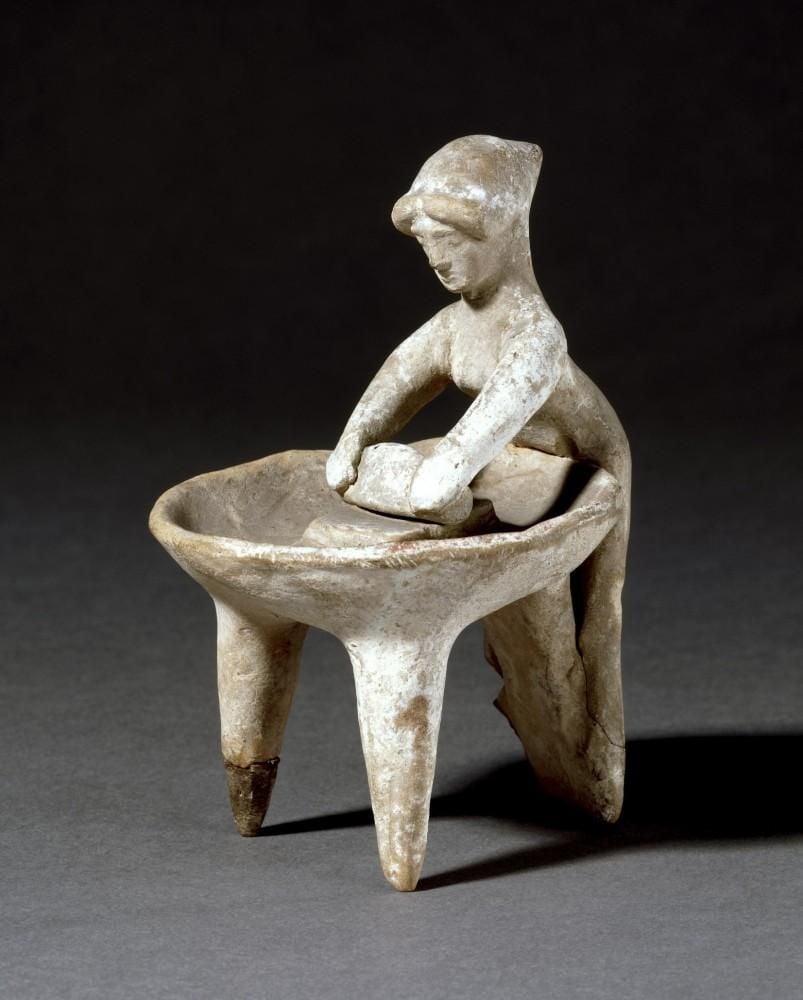
Guys! We can’t accept it just because it is said, even by a major museum. We have to think. Perhaps, if we were looking at this figurine in person, rather than via. a lowish resolution photograph, that we would see something that would make it clear. But, I don’t think so. The British Museum labels this a woman grinding grain. How could it be?
First, look at her body posture. is that the posture of a woman who, working a stone she holds in her hands sheers tooth-breaking hard grains into flour by rubbing the grain, under pressure, over a stone. In Egypt, and I know from person experience, in Ethiopia, there were and are grinding platforms where you could stand. But, they are built to work with our bodies to facilitate the work. She doesn’t have the body gesture of a person who is grinding grain.
From the same period (600 – 480 BCE) we see here two terra cotta grinding scenes. In addition to noting the body positions, look at what a mano looks like in the women’s hands. Now at what is in the hand of the standing woman who is alleged to be grinding grain.. Look into your heart. Is that a mano? Or, I that lump of dough? use your own body as a reference. How would you rub that, whatever it is, against a grindstone? Which side is against the stone? How do you control it?
If we defer to the principle of Occam’s razor, then isn’t that a lump of dough? Comments welcome!

I think it is pretty clear that we have woman standing at a bowl-table, working dough. Different height, different body posture, different object in her hand, then, yes, milling. This is working dough. If we take that idea as true, then we know the rough volume, and thus the rough weight of one batch or bread in circa 450 BCE.
Additional References
I recommend this article, from which I also found the above images.
This reference is given by the British Museum for the subject of this piece: Vandenabeele, F. 1986, ‘Phoenician influence on the Cypro-Archaic terracotta production and Cypriot influence abroad’, in V. Karageorghis (ed.), Cyprus between the Orient and the Occident (Nicosia: Department of Antiquities), 351-360.
 William Rubel