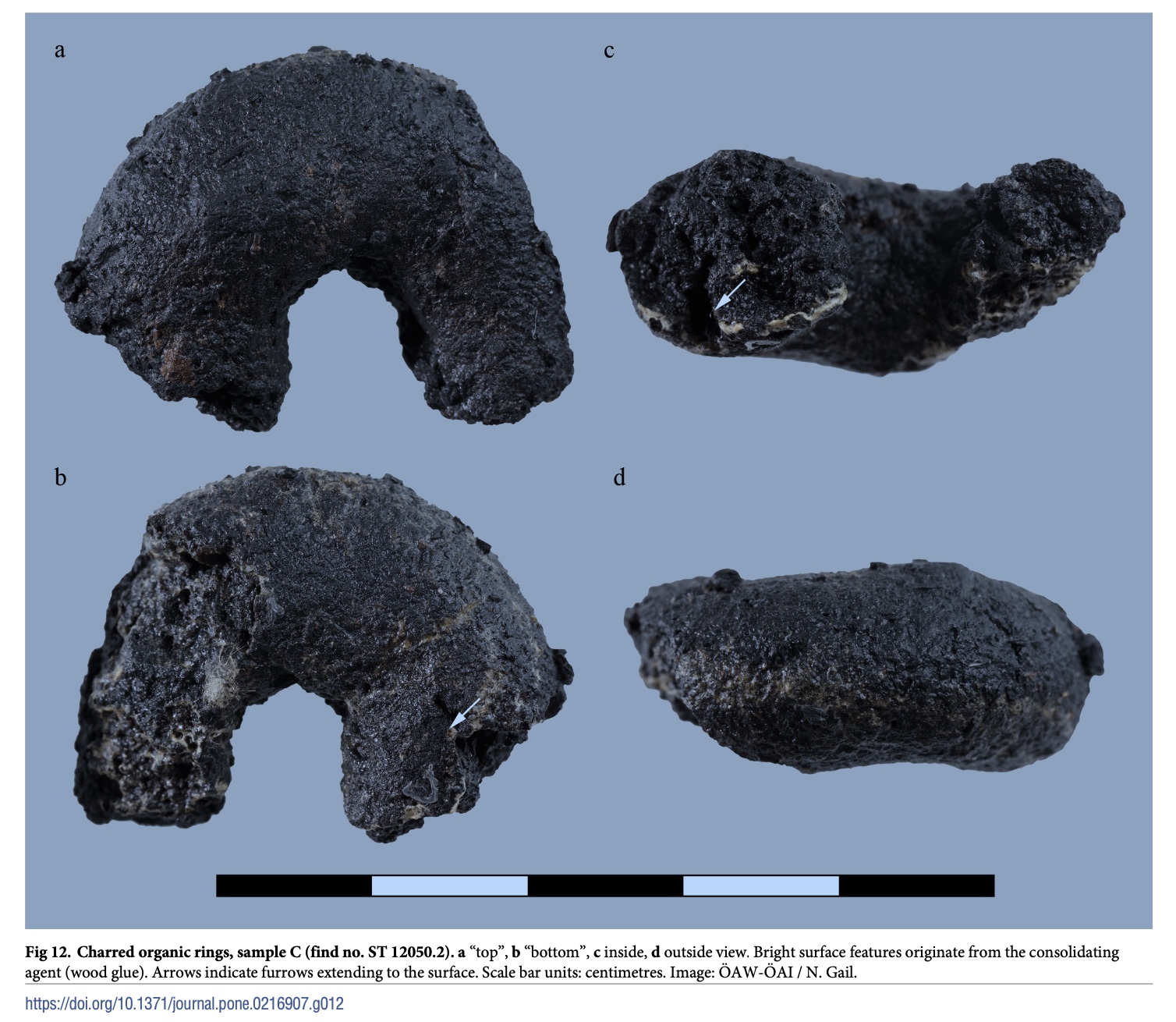
These carbonized rings were studied by Andreas Heiss, one of the leading archaeologists working today. These are made of uncooked dough. They were found along with clay rings that had been used as loom weights. Heiss, the primary author, may not be the only archeobotanist with a sense of humor. But he is the only archeobotanist I know of who brings humor into the title of his academic papers. I highly recommend The Hoard of the Rings: “Odd” annular bread-like objects as a case study for cereal-product diversity at the Late Bronze Age hillfort site of Stillfried (Lower Austria).
The find is a strange one — these breads and the clay weights were at the bottom of a pit that had been a grain storage pit and then at some point other things were put into it, and it seems to have been purposefully set on fire.
These are the grains that were found at the site: The overall cereal spectrum at Stillfried (site-wide) includes: Broomcorn millet (Panicum miliaceum): 60% (dominant crop). Hulled barley (Hordeum vulgare): 7%. Einkorn (Triticum monococcum): 9%. Spelt (Triticum spelta): 8%. Sanduri wheat (T. cf. timopheevii): 9%.
The breads were made of barley and wheat but did not include millet. The percentages of the barley and wheat were not determined. In English, a wheat and barley flour was referred to in the Early Modern period as maslin.
This is a Bronze Age attestation of the use of maslin flour in what is Bronze Age Europe. Maslin refers to any mix of bread grains and would also be the term to describe a mix of wheat and rye..
We have no idea why these uncooked dough disks were placed in the bottom of a grain storage pit along with loom weights. We also have no idea whether bread in this shape was baked in Bronze South Austria. On the other hand, who does’t like a little ring of bread? Sticking with the academic approach, we can only say that disc-shaped breads made of maslin are a possible bread form in the Austrian Bronze Age. However, not being an archeologist, and this not being a peer review paper, I I think I can extrapolate from this find to let our imagination extent to the idea that we might have picked up a handful of bread rings to take along as a snack on an afternoon outing, circa 1000 BCE.
 William Rubel